
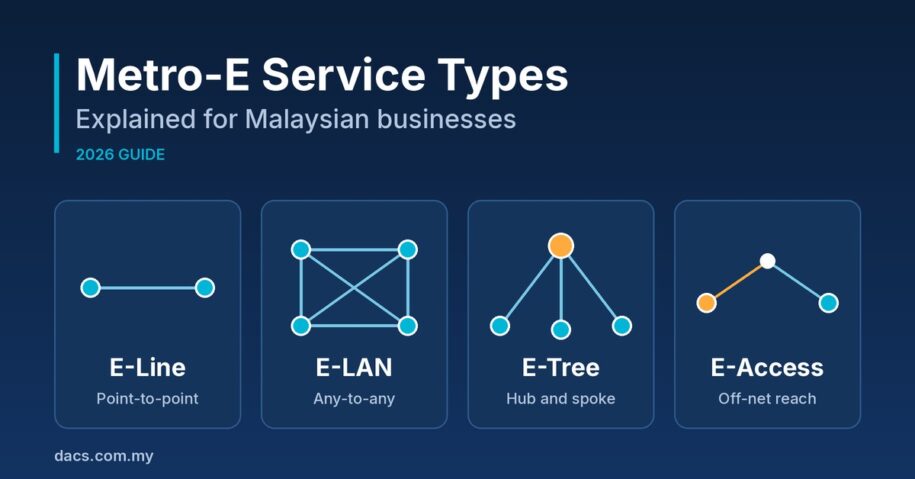
Quick answer: Metro Ethernet (Metro-E) services come in a few standard shapes. E-Line is a private point-to-point link between two sites. E-LAN joins three or more sites so that any site can reach any other, as if they were on one office network. E-Tree is hub and spoke: branches can reach the head office or data room, but not each other. E-Access is the wholesale piece behind the scenes, used when your provider reaches a site through another operator’s network. Knowing which shape you need makes it much easier to compare Metro-E quotes in Malaysia.
If Metro-E is new to you, start with our plain-English guide to what Metro Ethernet is. This article goes one level deeper, into the service types you will see on proposals and service order forms.
Why the service type matters
Two quotes can both say “Metro-E, 100 Mbps” and still describe different services. One may be a single link between two offices; another may be a shared private network for five branches. The service type decides how your sites talk to each other, how traffic is separated, how the network grows when you add a branch, and what you should check in the SLA. Getting the type right at the brief stage avoids a redesign after the order is signed.
The names used here come from industry-standard definitions published by MEF, the body that standardised carrier Ethernet services. Carriers in Malaysia do not always use these exact names in their product sheets, so treat them as a shared vocabulary: describe what you need in these terms, then ask each carrier which of its products delivers it.
E-Line: point-to-point between two sites
E-Line connects exactly two endpoints, for example a head office and a factory, or an office and a disaster recovery site. It behaves like a private cable between the two locations. Traffic does not touch the public internet.
E-Line typically comes in two forms:
- Port-based (often called EPL, Ethernet Private Line): the whole port at each end is dedicated to that one connection. It is simple and transparent; whatever you send in one end comes out the other.
- VLAN-based (often called EVPL, Ethernet Virtual Private Line): several virtual connections share one physical port, separated by VLAN tags. This is useful when a main site needs separate point-to-point links to several branches over a single port.
E-Line is the Metro-E service most similar to a traditional point-to-point leased line. If your need is strictly “site A to site B”, compare it with a leased line; our guide to what a leased line is explains the differences in delivery.
E-LAN: any-to-any for three or more sites
E-LAN links multiple sites into one private Layer 2 network. Every site can reach every other site directly, without traffic going through a head office first. To your IT team, the branches look like they are on the same network segment.
E-LAN suits businesses where branches regularly exchange data with each other, such as shared file servers, voice systems, CCTV recording at a central site, or applications hosted in more than one location. It also makes adding a site straightforward: the new branch joins the same service rather than needing separate links to each existing site.
As with E-Line, there are port-based and VLAN-based variants. The trade-off to keep in mind is that a flat any-to-any network needs good internal design. Plan your IP addressing, VLANs and broadcast control before go-live, especially with many sites.
E-Tree: hub and spoke with separated branches
E-Tree is a rooted multipoint service. One or more root sites (usually head office or the data room) can talk to all leaf sites, but leaves cannot talk to each other directly. That separation is built into the service rather than enforced only by firewall rules.
E-Tree fits retail chains, franchise outlets, clinics or branch offices that only need to reach central systems, and where branch-to-branch traffic is unwanted for security or simplicity. Not every carrier offers E-Tree as a named product; some deliver the same result with several E-Line circuits back to the hub, or with E-LAN plus filtering. Ask how the separation is achieved.
E-Access and E-Transit: the wholesale layer
Most buyers never order these directly, but they can affect your project. E-Access is used when your chosen provider does not have its own network at one of your addresses and buys an access circuit from another operator to reach it. E-Transit covers carrying a service across a third operator’s network between two others.
Why it matters to you: an “off-net” site served through another operator can have a different lead time, a different fault-handling path and sometimes different SLA terms from sites on the provider’s own network. When you compare quotes, ask which of your sites are on-net and which rely on a partner network.
How the service types compare
| Service type | Shape | Typical use | Watch for |
|---|---|---|---|
| E-Line | Two sites, point-to-point | Head office to factory, office to DR site | Port-based vs VLAN-based; compare with a leased line |
| E-LAN | Three or more sites, any-to-any | Branches that share servers, voice or CCTV | Internal network design as sites grow |
| E-Tree | Root to leaves, hub and spoke | Retail, clinics, outlets reaching HQ only | Whether the carrier offers it natively |
| E-Access | Provider reaches an off-net site | Sites outside the provider’s own footprint | Lead time, fault handling and SLA for off-net sites |
Where internet access fits in
None of these service types gives you internet access on its own. They connect your sites privately. Many businesses combine Metro-E with dedicated internet access (DIA): for example, DIA at head office with an E-Tree or E-LAN to the branches, or DIA at each site plus an E-Line between the two most important ones. Metro-E can also be the access method a carrier uses to deliver DIA to your building, which is one reason the terms get mixed up.
Our guide to choosing DIA, Metro-E or a leased line for multi-site businesses walks through common designs in more detail.
What to prepare before you ask for a Metro-E quote
- Full addresses for every site, including building name, floor and unit, and which site is the main one.
- The shape you need: point-to-point, any-to-any or hub and spoke, written in one sentence per site.
- Bandwidth per site, noting that the hub of an E-Tree or a busy E-LAN site usually needs more than the branches. Our bandwidth sizing guide helps with the estimate.
- Interface and handover: the port type your equipment expects, and whether you want port-based or VLAN-based delivery.
- Uptime needs: which sites can tolerate an outage and which need a protected path or a backup link. See our explainer on SLAs, MTTR and service credits.
- Timing: the date you need service, and the end date of any existing contract.
With that brief, DACS can compare options for your specific addresses on our Metro-E service page, or you can go straight to request a competitive quote.
Frequently asked questions
What is the difference between E-Line and E-LAN?
E-Line connects exactly two sites point-to-point. E-LAN connects three or more sites so that any site can reach any other directly. If you only have two locations, E-Line is usually the simpler fit; once branches need to exchange data with each other, E-LAN is worth considering.
Is E-Line the same as a leased line?
They do a similar job, a private connection between two sites, but the delivery differs. E-Line is an Ethernet service over a carrier’s Metro-E network, while a traditional leased line is a dedicated point-to-point circuit. Compare both for your addresses, since availability and handover options vary.
When should a business choose E-Tree?
Choose E-Tree when branches only need to reach a central site, such as head office or a data room, and should not talk to each other directly. It is common for retail outlets, clinics and franchise networks. If a carrier does not offer E-Tree as a product, ask how it would achieve the same separation.
Does Metro-E include internet access?
No. Metro-E service types connect your own sites privately. For internet access you add dedicated internet access at one or more sites. Metro-E is sometimes used as the access method that delivers DIA to a building, which is why the two are often mentioned together.
What does off-net mean on a Metro-E quote?
Off-net means the provider does not have its own network at that address and reaches it through another operator, typically using a wholesale access service. Off-net sites can have different lead times and fault-handling arrangements, so ask which sites are on-net and which are off-net before you compare quotes.
Related reading: What is Metro Ethernet? · DIA carriers in Malaysia compared · Moving office: planning your connectivity move · DIA FAQ
Last updated: 25 November 2026. This is general guidance; product names, availability, lead times and terms depend on your addresses and the carrier’s service order.